
Japan is known worldwide as a country that has many public holidays. By knowing when major holidays such as Golden Week, summer vacation (Obon), Silver Week, and the New Year holidays occur, it becomes easier to plan trips, visits to your hometown, work, or school schedules.
In this article, based on the 2026 Japanese calendar, we clearly explain when Golden Week, summer vacation (Obon), Silver Week, and winter vacation (New Year holidays) start and end. We also introduce useful tips for adjusting your schedule, such as how to extend your holidays by combining paid leave.
[2026] Japan Calendar|Public Holidays, Summer Vacation (Obon), Golden Week, New Year Holidays, and More
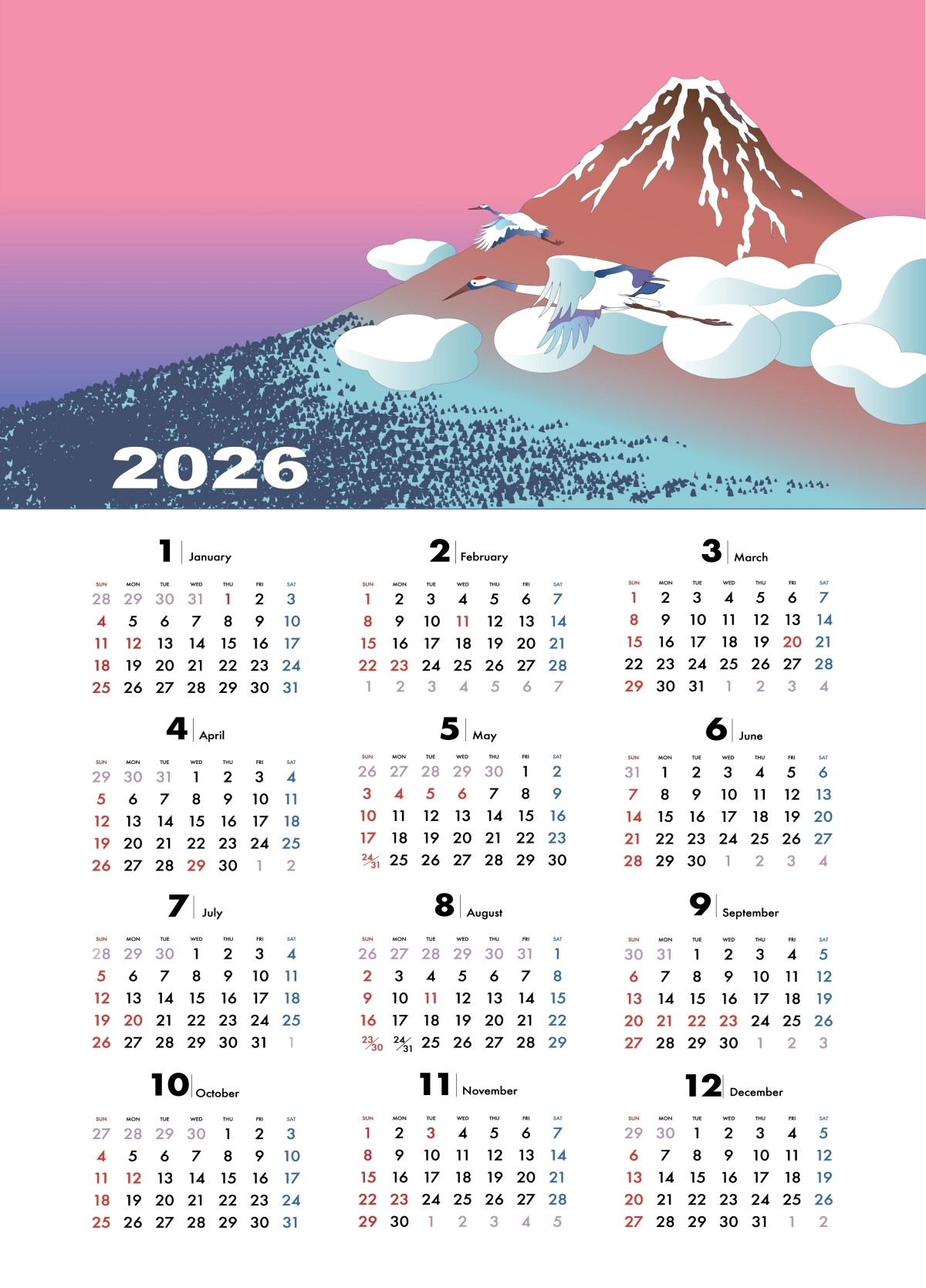
This is a calendar that allows you to check at a glance the public holidays and major long holidays in Japan for 2026 (Golden Week, summer vacation, Obon, Silver Week, and New Year holidays). It helps you quickly grasp the dates useful for planning trips, visiting family, or adjusting work and school schedules.
List of Japanese Public Holidays in 2026
| Holiday | Date in 2026 |
| New Year's Day | January 1 |
| Coming of Age Day | January 12 |
| National Foundation Day | February 11 |
| Emperor's Birthday | February 23 |
| Vernal Equinox Day | March 20 |
| Showa Day | April 29 |
| Constitution Memorial Day | May 3 |
| Greenery Day | May 4 |
| Children's Day | May 5 |
| Marine Day | July 20 |
| Mountain Day | August 11 |
| Respect for the Aged Day | September 21 |
| Autumnal Equinox Day | September 23 |
| Sports Day | October 12 |
| Culture Day | November 3 |
| Labor Thanksgiving Day | November 23 |
If you want to know more about the meaning of public holidays, please check the following article.
When Are the Long Holidays in 2026 (Reiwa 8), and How Many Are There?|Japan Calendar
List of Long Weekends in 2026 (Reiwa 8)
| Period | Details |
| January 10 (Sat) – 12 (Mon) | Saturday & Sunday + Coming of Age Day |
| February 21 (Sat) – 23 (Mon) | Saturday & Sunday + Emperor's Birthday |
| March 20 (Fri) – 22 (Sun) | Vernal Equinox Day + Saturday & Sunday |
| May 2 (Sat) – 6 (Wed) | Saturday + Constitution Memorial Day + Greenery Day + Children's Day + Substitute Holiday |
| July 18 (Sat) – 20 (Mon) | Saturday & Sunday + Marine Day |
| September 19 (Sat) – 23 (Wed) | Saturday & Sunday + Respect for the Aged Day + National Holiday + Autumnal Equinox Day |
| October 10 (Sat) – 12 (Mon) | Saturday & Sunday + Sports Day |
| November 21 (Sat) – 23 (Mon) | Saturday & Sunday + Labor Thanksgiving Day |
In Japan in 2026, there will be a total of eight long weekends of three days or more. Since there were nine in the previous year, 2025, it can be said that 2026 will have slightly fewer long weekends than usual.
On the other hand, holidays such as Golden Week in May and Silver Week in September will be longer and easier to take time off than in most years. In particular, Silver Week will feature a rare five-day holiday.
Additionally, there are cases where holidays such as Mountain Day (Tuesday, August 11) and Culture Day (Tuesday, November 3) fall alone on a weekday. These dates are likely to create split holidays, so by combining them with paid leave, it is easier to create a longer break.
Although many companies in Japan treat Saturdays, Sundays, and national holidays as days off, the handling of holidays varies depending on company policy. Even if a day is a national holiday on the calendar, it may be a regular workday, so it is essential to check your actual holiday schedule in advance.
【2026】When is Golden Week?|Japan’s Calendar
Golden Week in 2026: May 2–6
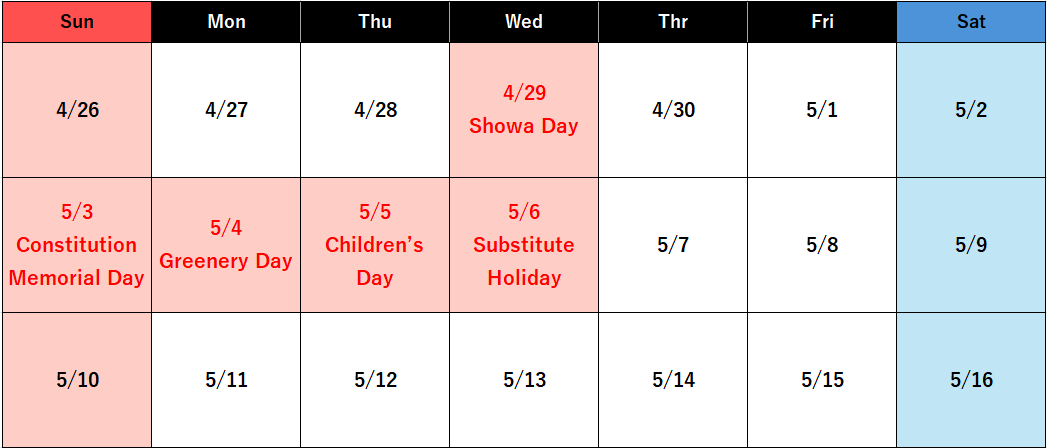
In 2026, Golden Week will be a five-day holiday from Saturday, May 2 to Wednesday, May 6. Even if you follow the standard calendar holidays, it’s easy to secure a substantial break.
Furthermore, if you take the weekdays within the period from Wednesday, April 29 (Showa Day) to Saturday, May 9 off, you can enjoy up to 12 consecutive days off.
Since Golden Week is a peak travel season, traveling long distances can mean dealing with crowds and higher prices. For this reason, many people choose to avoid long-distance travel and instead enjoy day trips or spread out their activities over several days.
Also, during this period, Japan enjoys comfortable weather before the real heat and rainy season set in. It’s a great time to stroll through city parks, explore nature spots in the suburbs, or go hiking nearby—enjoying the season while keeping travel distances short is one of the unique features of Golden Week.
Related article: What to Wear for Summer Travel in Japan? Recommended Outfits!
What does “Golden Week” mean?
Golden Week was created when several national holidays—Showa Day, Constitution Memorial Day, Greenery Day, and Children’s Day—were grouped together from late April to early May under the Act on National Holidays established in 1948. The name is said to have originated as a coined term in the film industry in the 1950s, when movie attendance surged during this period.
In Japan, it is known as one of the largest holiday periods of the year, when many people plan trips both domestically and abroad or return to their hometowns.
During this time, not only are tourist spots crowded, but transportation such as the Shinkansen, airplanes, and expressways are also packed with travelers. Therefore, it’s important to plan your travel with plenty of time to spare.
📅【2026】When Does Japan’s Long Holiday “Golden Week” Start and End?
Do Japanese companies close for Golden Week?
Most companies in Japan treat Saturdays, Sundays, and national holidays as days off, so it is common to have a long break during Golden Week. However, not all companies close on the same days.
Depending on the industry and company work rules, some may require employees to work on holidays, or only offer days off on certain dates. The actual number of days off and ease of taking a long holiday varies by company, so it’s best to check your company’s calendar in advance.
【2026】When is Summer Vacation (Obon)?|Japan’s Calendar
“Summer Vacation” (Obon) in 2026: August 13–16
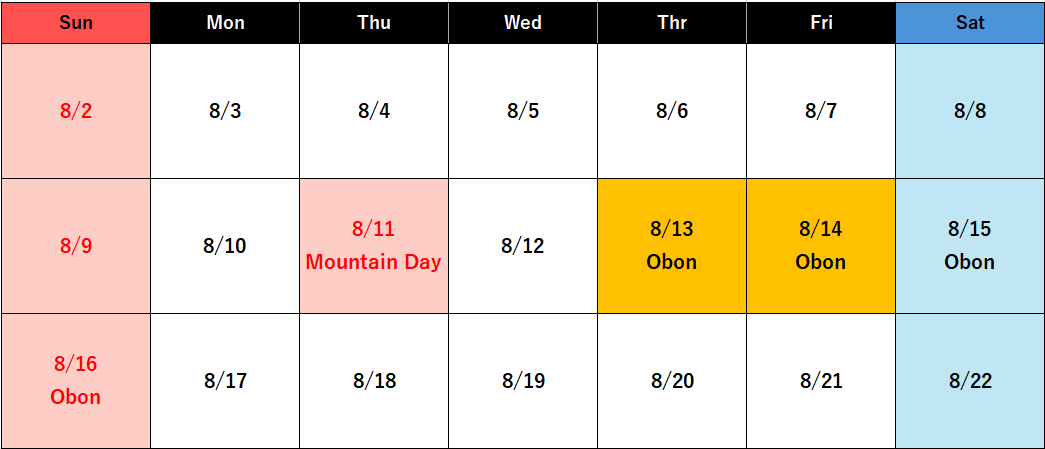
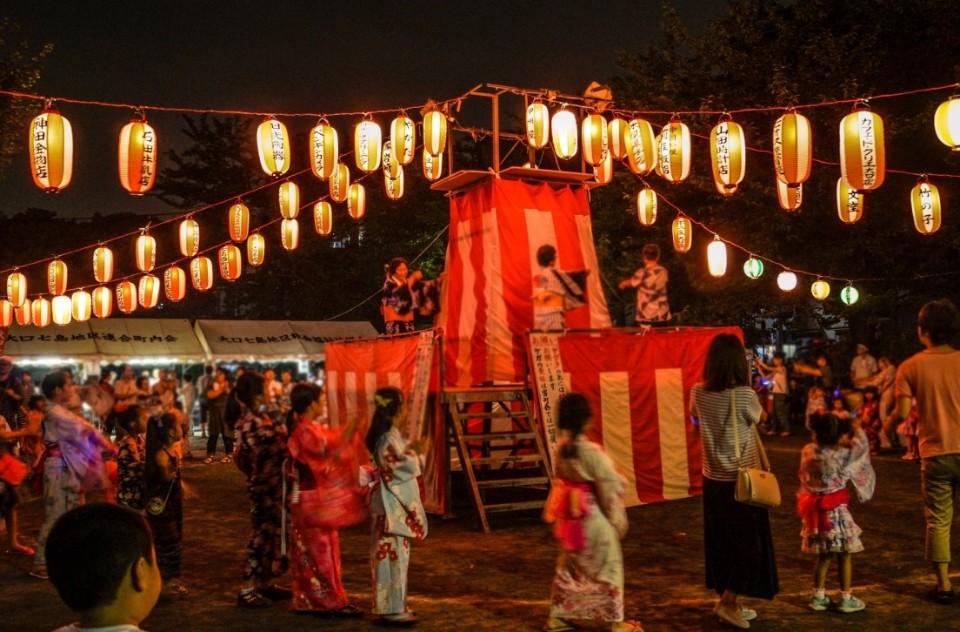
In present-day Japan, the schedule known as "Tsukiokure Bon" (Late Bon) is widely observed, and it is common to consider the four days from August 13 to 16 as one period for Obon. Centered around August 15th, events to welcome and send off ancestors are held, so this period is effectively treated as the Obon holiday.
August 13 is called "Bon no iri" (the start of Obon), when people light welcoming fires for their ancestors, and August 16th is "Bon ake" (the end of Obon), when sending-off fires are lit. In line with this flow, many companies and schools set their summer holidays during this period, making it a time when travel increases across society. However, the Obon period is not designated as a national holiday, so whether you get time off depends on your company.
In 2026, the Obon period overlaps with the weekend, so depending on how you take your holidays, it will be easier to have a longer break. If you take August 10th (Monday) and 12th (Wednesday) off, you can have up to nine consecutive days off, making it easier to plan trips home or vacations. However, this also means that transportation and tourist spots are likely to be crowded.
📅What is Obon? Thorough explanation of the period, Obon holidays, and the difference with Tokyo Obon
What do "Natsu Yasumi" (Summer Vacation) and "Obon" Mean?
In Japanese, "Summer vacation" is called "natsu yasumi (夏休み)" and is mainly used to refer to school holidays for students. In contrast, companies generally use the term "kaki kyuka" (summer leave).
Also, since the timing overlaps with summer vacation, it is sometimes referred to as "Obon" or "Obon yasumi" (Obon holiday). Obon is a traditional Japanese event to honor ancestors, and many people return to their hometowns during this period.
As a result, it is not uncommon for all non-reserved seats on the Shinkansen to be full or for major traffic jams to occur on highways. If you plan to use public transportation or tour buses, it is important to make reservations in advance and choose your travel times carefully. Also, be aware that accommodation prices tend to be higher than usual during this period.
Related article: When is summer vacation for Japanese schools? Recommended ways for elementary students to spend their time and grow [Japanese Parenting]
Do Japanese companies close for Obon?
The handling of Obon holidays varies by company, just like Golden Week. Many companies that use weekends and national holidays as their regular days off also set summer holidays to coincide with the Obon period.
However, since it is not a public holiday by law, not everyone gets time off at the same time. Depending on the industry and company policy, you may have to work as usual, so be sure to check your company's calendar in advance for the actual holiday schedule.
[2026] When is Silver Week? | Japan's Calendar
Silver Week 2026: September 19–23
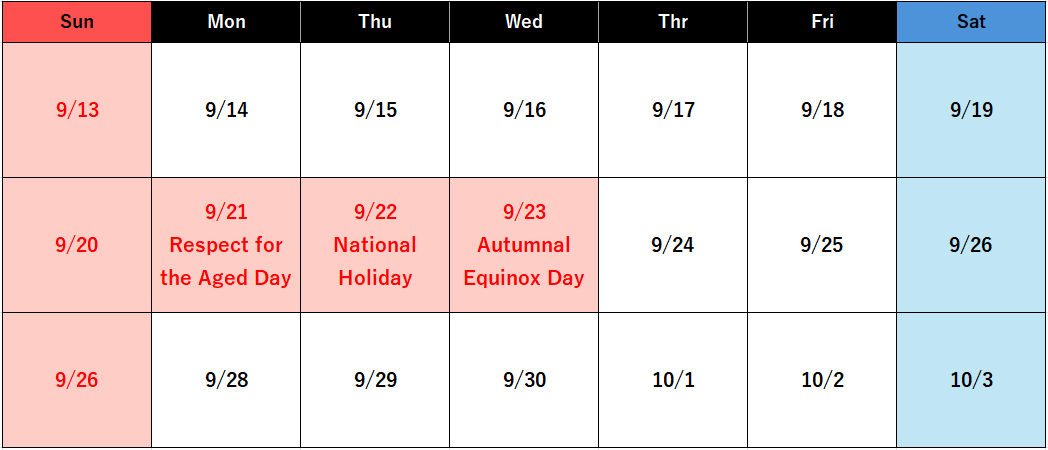
In 2026, Silver Week will be a five-day holiday from Saturday, September 19 to Wednesday, September 23. Having five consecutive holidays in September is rare, and this will be the first such long holiday in 11 years, since 2015.
Furthermore, if you can take paid leave on Thursday, September 24 and Friday, September 25, you can have up to nine consecutive days off. The next time September will have five consecutive holidays is in 2032, so the 2026 Silver Week is a valuable opportunity.
Autumn in Japan tends to have stable weather, without the heat of summer or the cold of winter, making it an easy time to plan trips and leisure activities. Many people use the holidays to travel both domestically and abroad.
What Does"Silver Week" Mean?
The term "Silver Week" became widely used starting in 2009. That year, Respect for the Aged Day and Autumnal Equinox Day were adjacent, resulting in a five-day holiday from September 19 to 23.
This extended holiday period attracted media attention, and the term "Silver Week" spread as a counterpart to the spring "Golden Week." However, unlike Golden Week, Silver Week does not occur every year.
For more about Silver Week, please see the following article.
📅[2026] When is the September long holiday "Silver Week"? A delightful five-day break is coming!
Do Japanese companies close for Silver Week?
The handling of Silver Week holidays varies by company, just like Golden Week and summer holidays. Companies that treat weekends and national holidays as days off often end up with consecutive holidays, but depending on the industry, there may be regular workdays as well.
Since non-holiday weekdays do not automatically become days off, it is best to check your company's holiday policy in advance to confirm the actual number of days off and your work schedule.
[2026] New Year Holidays (Winter Break): When do they start and end? | Japanese Calendar
The 2026 New Year Holidays are from December 29 to January 3
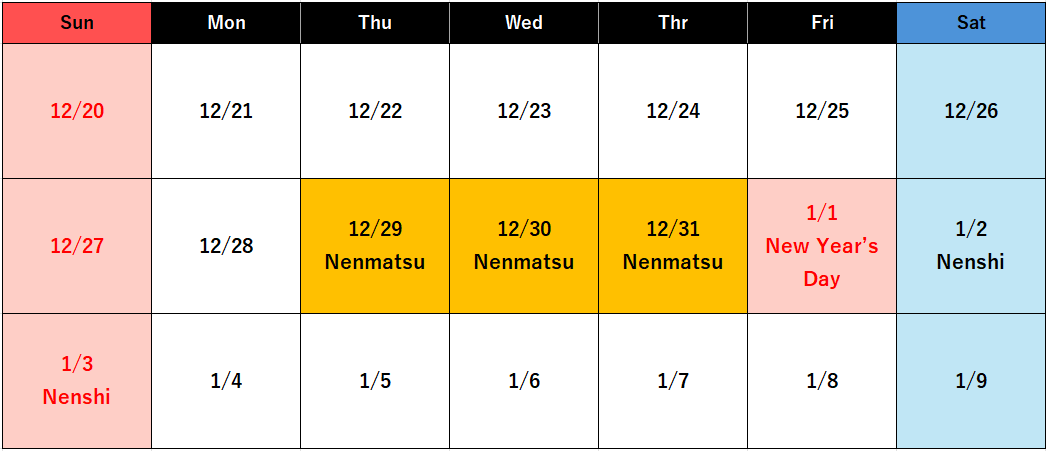
In 2026, the New Year holidays will generally be a six-day break from Tuesday, December 29 to Sunday, January 3, 2027. Government offices and many companies set their holidays according to this schedule, making it a period when the whole country takes on a festive atmosphere.
In 2026, New Year's Eve falls on a Thursday, and New Year's Day in 2027 is a Friday. If you can take a day off on Monday, December 28, it is possible to have up to nine consecutive days off from Saturday, December 26th to Sunday, January 3rd.
This period sees many people traveling to their hometowns or taking domestic trips, so transportation and major cities tend to be crowded. On the other hand, some tourist spots offer special events and hatsumode (first shrine visit of the year) unique to the New Year season.
For more about Japan's New Year holidays, please see the following article.
📅New Year holidays: Train operation information, and closures for banks and post offices? [2025-2026]
When are Japan's New Year Holidays? Japan Does Not Observe the Lunar New Year!
The term "fuyu yasumi" (winter break) is mainly used for students, while in companies, it is more common to refer to this period as "toki kyuka" (winter vacation) or "nenmatsu nenshi yasumi" (year-end and New Year holidays).
Japan uses the solar calendar, so the New Year is celebrated from January 1st to 3rd. In addition, the year-end break starts from December 29th. During this period, most companies and government offices are closed, and commercial facilities and tourist spots switch to special New Year operations.
On the other hand, the Lunar New Year is not a public holiday in Japan. Therefore, if you wish to take time off for the Lunar New Year, you will need to use paid leave or make individual arrangements.
When do Japanese companies start their New Year Holidays?
The handling of New Year holidays varies by company, just like Golden Week and Obon. Many companies start their holidays around December 29th, but depending on the industry, some may work until the end of the year.
Since this period includes non-holiday weekdays, be sure to check your company's work rules or internal calendar in advance to confirm the actual number of days off and workdays.
Rules for Taking Paid Leave in Japan
Paid leave in Japan is a system that allows workers to take time off to rest and refresh both mind and body. If you have worked for more than six months after joining a company and have an attendance rate of at least 80% during that period, you are entitled to at least 10 days of paid leave, regardless of whether you are a full-time, part-time, or temporary employee. The number of paid leave days increases gradually each year, so the longer you work, the more days off you can take. Basically, you do not need your company's permission to take paid leave; you simply notify them of the days you wish to take off. By combining paid leave with holidays before or after Golden Week or summer vacation, it is possible to enjoy even longer breaks.
Comments