
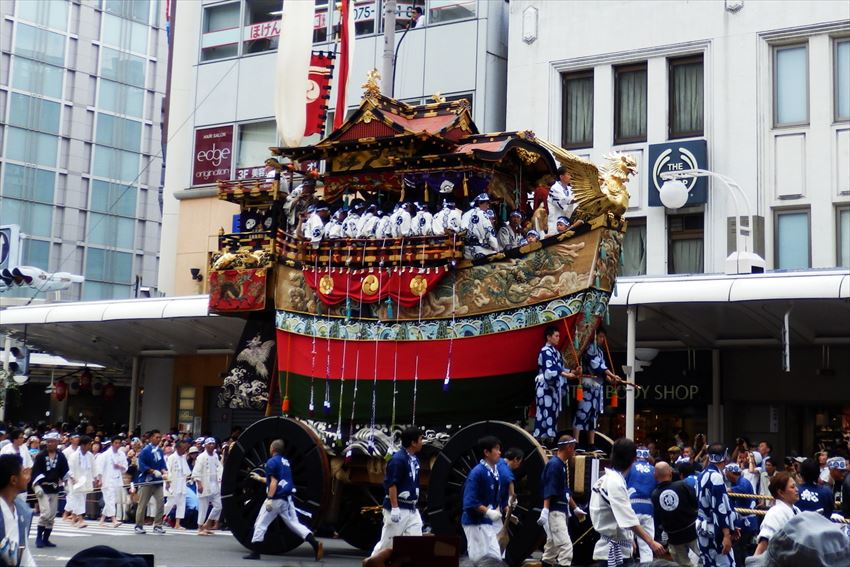
Every July, the Japanese parade extravagant floats of backbreaking proportions around select cities throughout the country. The most famous of these processions takes place in Kyoto. Here upwards of 30 floats are prepared during the course of the month and then exhibited on the streets. Men dressed in happis - cotton jackets with matching headbands - sweat and strain against the ropes as the sun beats on the back of their necks. Inside the float, a band sits playing songs on traditional instruments. This is the Gion Festival.
(https://www.flickr.com/photos/126057645@N04/14676773692/)
While Kyoto’s is the most well known, other cities around Japan observe the Gion Festival as well. One of the most “festive” of these is in Hita, a small rural city located in the heart of Kyushu. Hita is easily reached by bus or car from Fukuoka City as well as from Beppu. During the summer, Hita’s historical district, Mameda, fills with tourists looking for traditional Japanese wares such as sake, sandals called geta, pottery, and more.
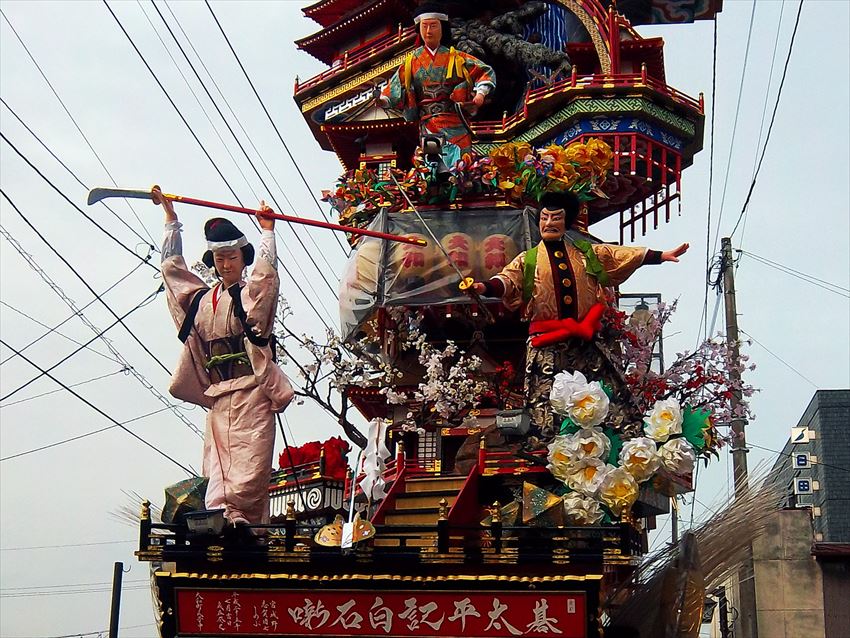
Gion in Hita is held during the first weekend after July 20th. For two days, locals from the eight participating districts push and pull their floats (called Yamaboko in Japanese) throughout the city. The largest of these floats can tower up to 12 meters in height.
(https://www.facebook.com/WorldWideWojnar/)
As if dragging their incredible weight around was not enough, whenever two or more floats cross paths at an intersection, they are obliged to demonstrate their strength by lifting and even spinning the entire float around as many as three times! To perform this undertaking, the leading rope is detached, those pushing climb onto the back of the float, and reinforcements come to the front to precariously tilt the whole ensemble.
(https://worldwidewojnar.wordpress.com/)
Parade Locations
There are two main courses which the floats follow. Four of the smaller floats pass through the aforementioned historical district: Mameda. These floats are limited in height due to the amount of electrical wires criss-crossing the streets overhead. In fact, at the top of each float, a lookout holding a wooden pole lifts hanging wires so that none get caught. The floats eventually stand on two parallel bridges over the Kagetsu River. Here, one will see an extended demonstration of might, including the lifting and spinning of the floats, as well as a fan dance.
The other four floats pass through Kuma-machi, a district adjacent to the Mikuma River. It is easiest to reach this district by following the street leading perpendicularly away from Hita Station. As with any respectable festival, one can eat their fill of yakitori, cotton candy, and everything in between from the close to one hundred stalls (called yatai) located along the street.
(https://worldwidewojnar.wordpress.com/)
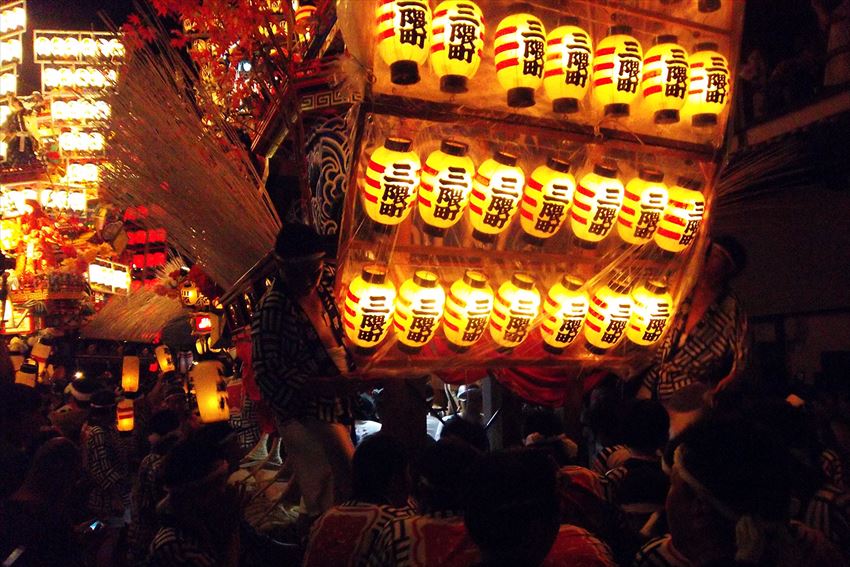
Two days prior to the main parade, the eight floats gather in front of the main train station. For the enjoyment of onlookers, the floats take turns being lifted and swayed from side to side. During this first day, the teams work hard for the pride of their district, which is written on each of the lanterns attached to the floats as well as on the back of their happis.
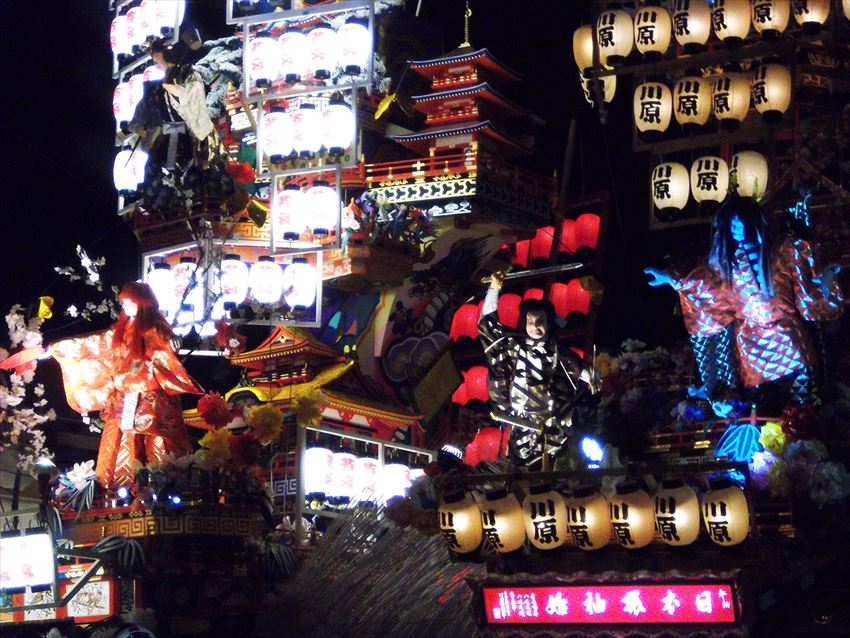
When it gets dark, the floats’ lanterns are illuminated, bestowing a romantic atmosphere onto the festival. The teams repeat their morning trek around their district once more in the evening, making the Gion Festival a display of neighborhood pride, personal endurance, and team unity.
Lodging
The festival takes place over the course of a few days. Because demand (and prices!) during the festival increase dramatically, it is recommended to book a hotel early. There are no hostels and few budget options available in the city.
For those seeking luxury, Mikuma Hotel and Kizantei Hotel offer a front seat view on the Mikuma River as well as easy access to the festival.

Comments